
I was sitting in a conference room at a company retreat, nursing a lukewarm coffee, when the guest speaker launched into a story I’d heard a dozen times.
A charismatic consultant brought in to talk about disruptive innovation. To make his point about the stifling nature of rules and legacy systems, he started the tale of the two horses’ asses.
As he told it, the story was a perfect parable. An unbroken two-thousand-year line from the width of a Roman war chariot to the design of the Space Shuttle’s rocket boosters.
The room nodded along. It’s a seductive myth because it feels true. It has a clear villain - mindless adherence to the past - and it confirms a bias many creative people carry: that standards are the enemy of progress.
It’s a memorable anecdote. It gives us permission to resent the constraints we work under.
The problem is, the story isn’t just factually wrong. The lesson it imparts is a dangerous foundation for building an innovative and resilient organization.
I’ve spent my career as an engineer, and now as a Head of Engineering, building systems - technical and human - that create things. This myth gets it backward.
This is the story of how I learned to stop worrying and love the right kind of standards, and why that philosophy extends from our code architecture to the most important standard of all - how we treat our people.
Table of contents
Open Table of contents
Part 1: The Myth Under Microscope
Before building a better foundation, demolish the old one. The “two horses’ asses” story is compelling because of its grand sweep. It goes like this:
The standard U.S. railroad gauge is an odd 4 feet, 8.5 inches. This is because the first U.S. railroads were built by English engineers who used the English standard. They used that gauge because the first rail lines were built by the same people who made pre-railroad tramways and they simply used the same jigs and tools. Those tramways had that specific wheel spacing to fit the ruts in England’s old, long-distance roads, lest the wagon wheels break. Those roads, in turn, were built by Imperial Rome for their legions. The ruts were first formed by Roman war chariots, which were all built to a standard width. And why that width? Because they had to be just wide enough to accommodate the back ends of two war horses.
The modern twist:
the Space Shuttle’s Solid Rocket Boosters (SRBs), built by Thiokol in Utah, had to be shipped by train to the launch site in Florida. The railway line passed through a mountain tunnel that was only slightly wider than the track. Therefore, a major design feature of one of the most advanced transportation systems in human history was ultimately determined by the width of two horses’ asses.
Fantastic story. Mostly wrong.

Fact-checkers have investigated this legend thoroughly. There are kernels of truth, but the causal chain breaks in multiple places.
The Roman connection is more coincidence than causality. The width of a cart pulled by two horses in harness is a practical limitation that emerged independently in many places. A prosaic link, not a direct inheritance. Rail gauges across the former Roman Empire aren’t uniform - if ruts in Roman roads had been the cause, they would be.
The real origin of the standard gauge is more pragmatic and much less ancient. George Stephenson, a pioneer of railways, worked with English mining tramways that used various gauges. For his Stockton and Darlington Railway he chose one that worked: 4 feet, 8 inches. By the time Britain considered a national standard, there were already 1,200 miles of Stephenson gauge in the ground. Network effects did the rest.
Adoption in the United States wasn’t a straight inheritance either. Many early lines used Stephenson gauge, others used different widths. The eventual standardization was largely a political and logistical outcome of the U.S. Civil War - the North predominantly used 4 feet 8.5 inches, won the war, and rebuilt much of the Southern railway system to match.
The Space Shuttle conclusion is a fabrication. The story about SRBs constrained by a tunnel “slightly wider than the railroad track” is false. Railway tunnels are built with significant clearance. That part was invented to give the legend a modern punchline.
The real danger isn’t the historical inaccuracy. It’s why the story is so popular. The myth persists because it offers a simple, deterministic explanation for a complex system, and it validates our aversion to what we perceive as arbitrary constraints.
It’s a story about path dependency - a dangerously oversimplified one. It encourages a “burn it all down” mindset: all standards are arbitrary and stifling. It fails to distinguish between bad, outdated constraints and the good, enabling ones that are the real engines of progress.
Part 2: Standards as Innovation Engines
The horses’ asses story paints standards as a cage. The right standards aren’t a cage - they’re a scaffold. A structure that lets us build higher, faster, and more safely than we could in chaos.
The key is the distinction between two kinds of standards.
Prescriptive standards dictate a specific implementation. They tell you what to do and how to do it. They stifle creativity.
Enabling standards define a common interface, protocol or set of rules, creating a stable platform on which creativity can flourish. They don’t tell you what to build. They tell you how to connect.
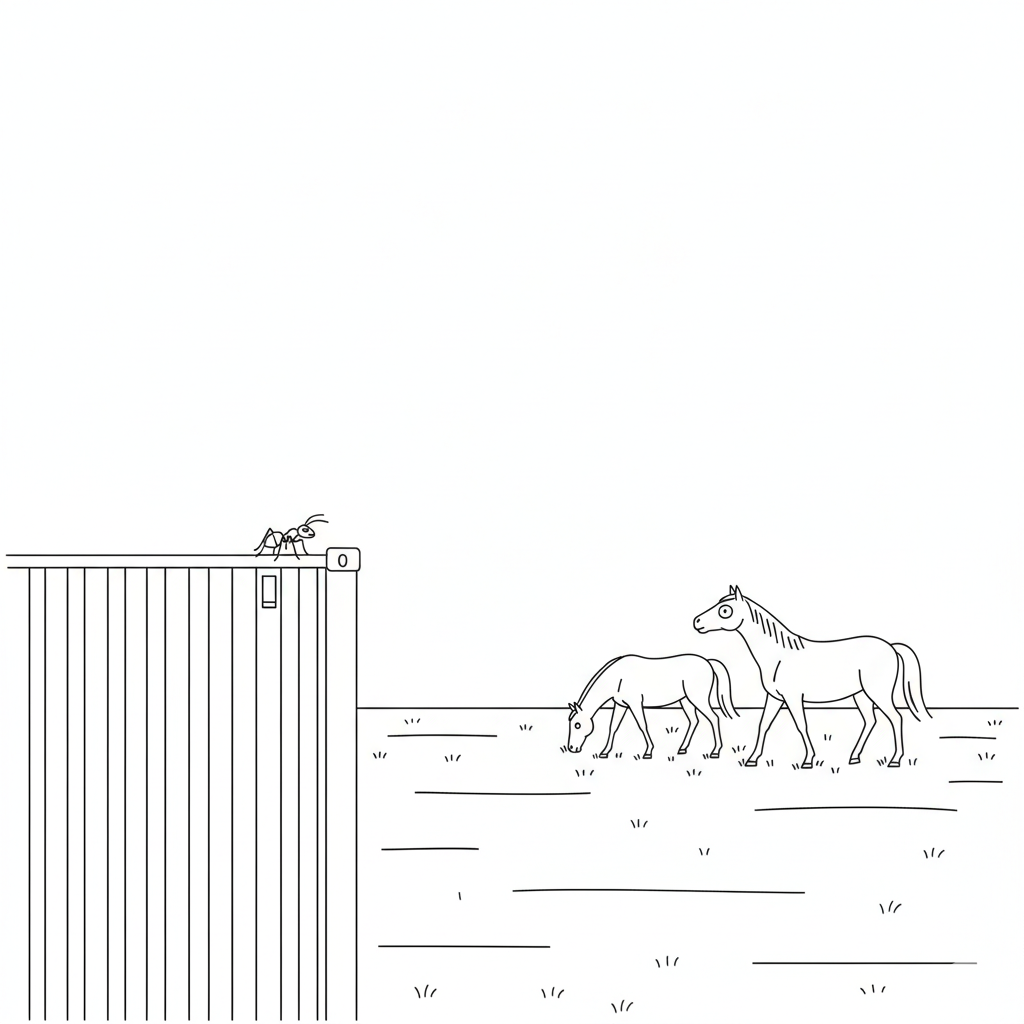
Before the 1950s, loading a ship was chaotic and expensive - break-bulk shipping. Goods in sacks, barrels, and crates of every size, manually loaded by teams of longshoremen. Weeks to load and unload a single vessel. Significant losses from damage and theft.
Then a trucking entrepreneur named Malcom McLean had a revolutionary idea: load the whole truck trailer onto the ship. This evolved into the intermodal shipping container. The genius was not in the box itself but in standardizing its dimensions. In 1968, the International Standards Organisation set the familiar dimensions (initially 20 feet long, 8 feet high, 8 feet wide) and corner fittings.
This enabling standard created a seamless global logistics platform. The same box could move by truck, rail, and ship without being unpacked. Port congestion fell. Shipping time fell. Costs fell.
The impact was staggering. The shipping container “has been more of a driver of globalization than all trade agreements in the past 50 years together”.
The standard didn’t dictate what went inside. It created a reliable system that unleashed global manufacturing and trade.
In the digital world, the most important enabling standard is TCP/IP.
Developed in the 1970s by Vint Cerf and Bob Kahn for a U.S. Department of Defense project, its goal was to let different computer networks communicate reliably. The brilliance is layered simplicity. TCP breaks data into small packets and ensures they’re reassembled correctly at the destination. IP acts as the postal service - each packet gets an address and routes through the network.
Email. The Web. Cloud. Video streaming. All of it rides on that foundational standard. It lowered the barrier for innovators who no longer had to worry about the underlying plumbing. They could just build.
This brings the argument into software engineering.
APIs are the modern incarnation of enabling standards. A contract between software components, no internal details required. Well-defined API specifications like OpenAPI let teams build complex systems faster and more reliably.
We avoid recreating the wheel by plugging into existing functionality. Stripe for payments. Google for maps. Internal microservices APIs for new features. Parallel development becomes possible - different teams on different components, confident they’ll connect as long as they adhere to the contract.
These standards don’t just accelerate innovation. They create markets. AccuWeather, Stripe - massive businesses built by monetizing access to data and services through clean APIs. The API economy is real. Here, the standard isn’t just an enabler of the product. The standard is the product.
Part 3: High Care, High Performance - Choosing Your Poison
Enabling standards create the conditions for innovation. That brings me back to the retreat and its second, more insidious myth: the idea that a company can simultaneously achieve High Care and High Performance.
This is a comforting fiction. It ignores a fundamental law of systems and human nature: you cannot maximize two competing variables at once.
The tension between caring for people and holding them to extreme performance standards isn’t something to be “balanced”. It’s a direct trade-off. To maximize one, you sacrifice the other.
The corporate world loves the elite athlete as a model for performance. It conveniently ignores what that model represents. An elite athlete is a case study in the complete sacrifice of “care” for the singular goal of “performance”.
Their lives are defined by what they give up. Social lives - missed weddings, birthdays, holidays. Brutal training regimes. Punishing diets. Precarious financial stability. Strained personal relationships.
Australian field hockey player Matt Dawson amputated the tip of his finger to be able to compete in the 2024 Paris Olympics after a severe injury in a practice match. Surgery to repair the broken finger would have required months of recovery, so he chose amputation, which had a much shorter recovery time, to ensure he would be fit for his third Olympic Games.
That’s the reality of peak performance. It isn’t a balanced life. It’s a life where well-being, relationships, and personal comfort are consciously sacrificed on the altar of results.
Pretending we can demand this level of performance without also demanding a similar sacrifice is naive at best and dishonest at worst.
In the business world, this trade-off shows up as burnout.
A culture that relentlessly prioritizes high performance creates high pressure, unrealistic expectations, and a lack of psychological safety. The result is not a thriving workforce. It’s a predictable cycle of exhaustion and turnover.
The most damning pattern is who gets hurt the most. It’s consistently the high performers. The traits that make them exceptional - high standards, emotional investment, willingness to take on responsibility - drive them into exhaustion in a low-care system. Your most productive employees have the lowest capacity to recover from stress, making them the highest risk for turnover.
The financial cost is in the hundreds of billions annually in lost productivity and healthcare.
This isn’t a system failure. It’s the system working as designed. A high-performance culture, by its nature, treats human capital as a resource to be consumed.
The choice isn’t how to achieve both. It’s which to prioritize.
Leaders face a stark choice:
-
High Performance with Lower Care. Aggressive goals. Burnout and turnover accepted as costs of doing business. Optimizes for output. Consumes its most dedicated people.
-
High Care with Lower Performance. Employee well-being, psychological safety, sustainable pace. Fosters loyalty and stability. Accepts that it may not hit the same aggressive targets or market-beating results as more ruthless competitors.
Pretending there’s a magical third option is how you set up both your organization and your people for failure.
Conclusion: What Is Your Foundation?
The stories we tell ourselves matter. They shape our strategies, architectures, and cultures.
We started with a folksy but false story - the “two horses’ asses” myth - that championed a chaotic, anti-standards view of innovation. We took it apart. The real history of progress is pragmatic choices and enabling standards.
That leads to a harder truth.
The most popular story in corporate culture today is the myth that we can build an organization of High Care and High Performance without compromise. It’s as misleading as the story about Roman chariots.
As leaders, we have to choose our foundation with open eyes, acknowledging the trade-offs.
-
We can build a foundation for High Performance. Results, speed, market dominance. A culture that attracts and rewards elite performers and must accept the inevitable cost - higher burnout, higher turnover, the risk of a toxic environment where people are sacrificed for metrics.
-
We can build a foundation for High Care. Sustainability, psychological safety, well-being. A culture that builds loyalty and retains talent and must accept it may move slower and hit less aggressive outcomes than more ruthless competitors.
The greatest failure of leadership isn’t choosing one path over the other. It’s pretending you can have both.

Discard the comforting myths. Be honest about the sacrifices required for your ambitions. Build the foundation not on the asses of two long-dead horses or on feel-good corporate slogans, but on a clear-eyed understanding of the trade-offs you’re willing to make for the results you want.